
Recent Post


The Price Objection Is Not the Real Problem - Part 2/3
Stephane Reinhardt
Oct 07, 2026
The Patient Never Said "No!"
Did the Patient Say It Was Too Expensive, or Did the Team Decide That?
Why assuming what patients can afford can prevent informed choice before the conversation even begins
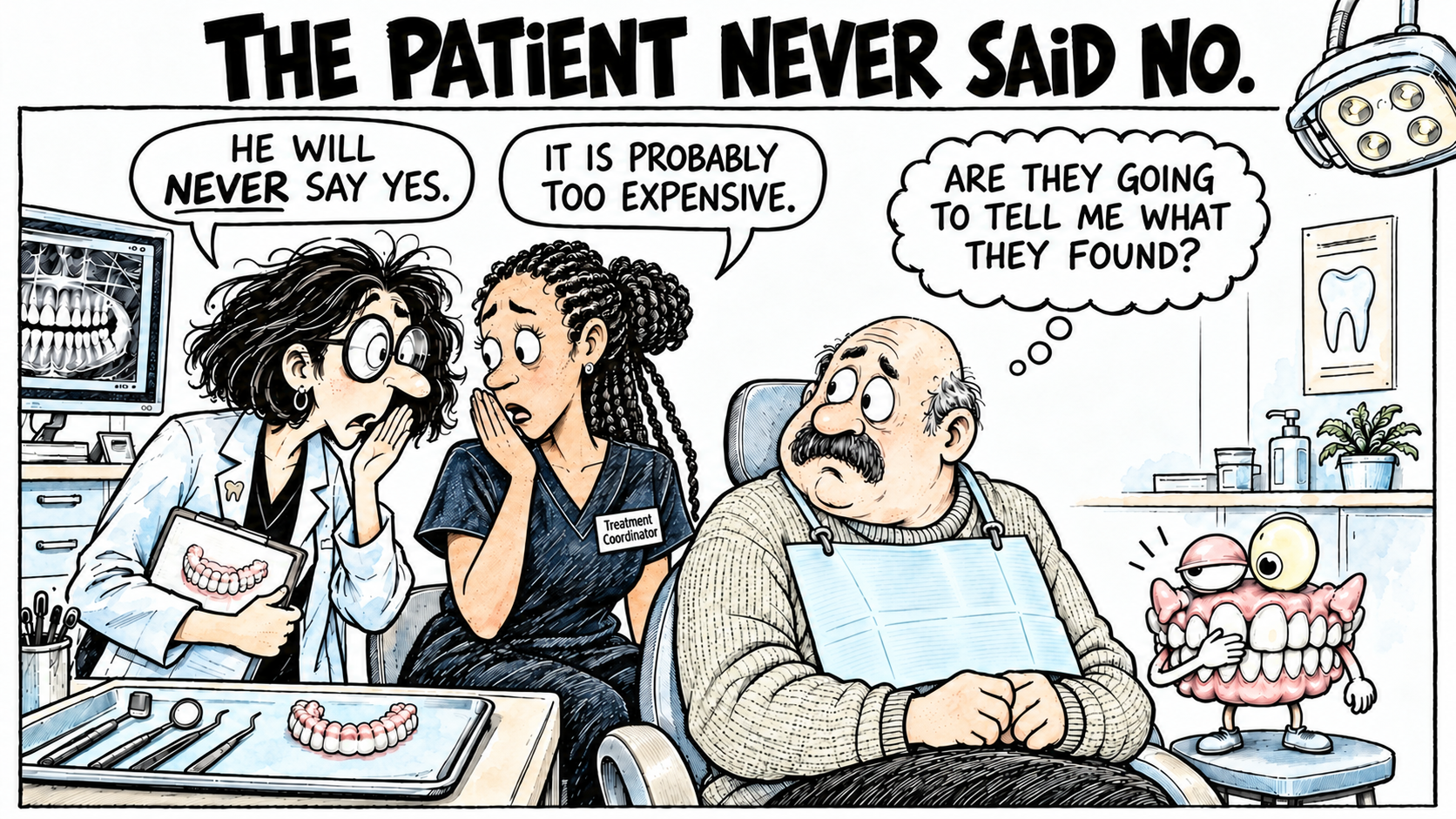
The patient never said no.
Sometimes, we say it for them.
It can happen before the consultation. During the morning meeting, someone looks at the schedule and says:
“She will never go for clear aligners. It is too expensive for her.”
Perhaps nobody says it aloud. The assumption may appear in a shorter explanation, an apologetic tone, or a recommendation that is never mentioned at all.
The patient has not rejected treatment. The patient has not even been given the opportunity to consider it.
This is Part 2 of the three part series The Price Objection Is Not the Real Problem. In Part 1, we looked at what happens when a patient tells us treatment is too expensive. Part 2 begins one step earlier, when the objection may exist only in our own minds.

The team can create an objection the patient never expressed
Dental teams know their patients. We remember their history, their concerns, and sometimes difficult financial conversations from the past. That knowledge can make us thoughtful. It can also make us overconfident in what we think we know.
We may interpret the patient’s clothes, job, insurance, address, family situation, or previous choices as evidence of what they will or will not accept. We may also project our own relationship with money onto them.
Then, without realizing it, we begin making a financial decision on the patient’s behalf.
The problem is not only that our assumption may be wrong. The deeper problem is that the patient loses the opportunity to understand the diagnosis, consider the options, ask questions, and decide what matters to them.
Good intentions can still remove choice
Most teams are not trying to withhold care. Often, they are trying to protect the patient from embarrassment or pressure. They do not want the consultation to feel commercial. Those are good intentions.
But avoiding a recommendation because we fear the price conversation does not protect the patient. It quietly replaces the patient’s judgment with ours.
There is an important difference between presenting every possible treatment as a sale and explaining a clinically relevant option as part of comprehensive care.
Our role is not to persuade every patient to accept clear aligner treatment. Our role is to recognize the problem, explain why it matters, present reasonable options, and allow the patient to choose.

Diagnosis belongs before affordability
A financial discussion should never erase a diagnosis.
If crowding compromises hygiene, if tooth position affects restorative planning, if occlusion creates risk, or if alignment could improve a comprehensive treatment plan, the patient deserves to understand that.
They may decide to proceed. They may decline. They may say not now. Each answer can be appropriate.
But an informed no is very different from an option that was never presented.
A previous "No" should not create permanent silence
There is another way we sometimes decide for the patient. We discussed clear aligner treatment once, the patient did not proceed, and we conclude that they are not interested. At every future visit, we stop mentioning it.
Would we do the same thing with caries?
If we diagnosed caries and the patient returned a year later without completing treatment, would we ignore it because we had already discussed it once? Would we stop talking about active periodontal disease because the patient had previously declined treatment?
Of course not. We would reassess, explain what we see, discuss the consequences, and present the options again. We do that because we believe in the diagnosis, the treatment, and the benefit it can bring.
When clear aligner treatment is mentioned once and then disappears from every future conversation, the patient may reasonably conclude that it was never very important. They may think it was purely elective, or simply something the practice wanted to sell at that particular visit.
If tooth position remains clinically relevant, it should remain part of the clinical conversation. That does not mean repeating a sales pitch at every appointment. It means reassessing, documenting, and explaining the recommendation again when appropriate, just as we would with other untreated conditions.
The goal is not to make every patient say yes. The goal is to make sure that when the patient is ready, whether that is next month, next year, or several years from now, they remember the diagnosis, understand the value, and trust the team that respected their timing.
Patients rarely decide when we are ready for them to begin. They decide when they are ready. Our responsibility is to keep the door open without pushing them through it.

Listen to the language around the patient
Financial assumptions often reveal themselves in small phrases:
“They will never pay for that.”
“This patient only wants what insurance covers.”
“Do not mention comprehensive treatment. Keep it simple.”
“She is not an aligner patient.”
“He already said dentistry is expensive.”
None of these statements necessarily describes what the patient wants today. They describe what the team predicts.
A better question is: What has the patient actually told us?
Present the diagnosis without presenting pressure
Being complete does not require becoming aggressive. The conversation can remain calm, clinical, and respectful.
Instead of deciding what the patient can afford, try language such as:
“Here is what I see, and here is why it may matter over time.”
“There are several ways we could approach this. Would you like me to explain them?”
“This is one option, not an obligation.”
“You do not have to decide today.”
“If now is not the right time, we can document it and revisit it later.”
This language keeps the diagnosis clear while leaving ownership of the decision with the patient.
Three questions for the next team meeting
When someone says that a patient will not accept treatment, pause and ask:
- Did the patient actually express a financial concern?
- Did we clearly explain the diagnosis and why treatment was recommended?
- Did the patient have a genuine opportunity to ask questions and decide?
If the answer to any of these questions is no, the objection may belong to the team, not the patient.
The goal is not more acceptance
This is not a strategy for making every patient say yes.
The goal is a better decision.
Sometimes that decision will be yes. Sometimes it will be no. Sometimes it will be not now.
What matters is that the patient is responding to a diagnosis and a meaningful choice, not to the limits of what the dental team assumed was possible.
Patients may surprise us. But first, we have to stop answering for them.
Continue the series
This is Part 2 of The Price Objection Is Not the Real Problem.
In Part 3, we will explore why “not now” does not mean “never,” and why respecting a patient’s timing does not mean erasing the diagnosis.
What phrases have you heard in a dental office that may reveal a financial assumption about a patient? Share your experience in the comments.
About The CLEAR Institute
The CLEAR Institute provides education and coaching for dentists who want to integrate clear aligner treatment confidently and predictably into daily practice.
Our programs focus on understanding principles, biomechanics, and treatment planning rather than following rigid recipes.
Because when clinicians truly understand the mechanics behind clear aligner therapy, treatment planning becomes simpler, more predictable, and significantly more enjoyable.
If you would like to explore more educational resources from The CLEAR Institute:
✅ Explore all CLEAR resources, programs, and services: https://bit.ly/clearlinktree
✅ Learn more about our MOCA programs for mastering clear aligner treatment planning: https://learn.theclearinstitute.com
✅ Need help reviewing a virtual setup such as a ClinCheck? Submit your case for a personalized expert video review with ClearCheck: https://bit.ly/clear_check
These resources are designed to help dentists develop the confidence and clinical reasoning needed to integrate clear aligner therapy successfully
Share this post:
Get in touch
Let's be CLEAR
Your journey to mastering clear aligner treatment matters to us. Reach out and our team will connect with you shortly.
Fast response
Faster than a cuspid rotates
We are currently helping passionate dentists build confidence in clear aligner therapy. Stay inspired, we will be in touch soon.


Direct line
Eva Wittenberg
CLEAR Experience Manager
Languages: English, French, German, Spanish
WRITE EVALearning path
Meet with Eva
15 minute guidance call
Review your objectives, clinical experience, and the most relevant next step within the CLEAR programs.
BOOK A CALL