
Recent Post


The Price Objection Is Not the Real Problem - Part 1/3
Stephane Reinhardt
Jul 14, 2026
Your clear aligner treatment is too expensive, Doc! - Part 1 of a three part series
“Clear aligner treatment is too expensive.”
Many dentists hear those words and immediately begin defending the fee.
We explain what is included. We talk about the technology, the appointments, the treatment planning, the monitoring, the refinements, and the retainers. We divide the total by the number of months. Sometimes, before the patient has even finished the sentence, we start discussing payment options.
We believe we are explaining value.
The patient may feel that we are trying to win an argument.
I take a very different approach.
When a patient tells me clear aligner treatment is expensive, I say:

Then I stop talking.
That sentence changes the conversation because there is nothing left to fight.
Why defending the fee creates resistance
Our instinct to justify the fee is understandable. A properly planned clear aligner treatment involves much more than providing a series of plastic trays.
The fee reflects diagnosis, records, treatment planning, clinical judgment, monitoring, adjustments, refinements when appropriate, retention, team involvement, and professional responsibility throughout the process.
All of that matters.
But timing matters too.
When the first response to a patient’s concern is a long explanation, we may unintentionally communicate discomfort. It can sound as though we need the patient to agree that our fee is reasonable.
The conversation becomes a debate. The dentist tries to prove the treatment is worth the money. The patient feels compelled to defend the right to think it is expensive.
Nobody wins.
Clear aligner treatment can represent a significant investment. Pretending otherwise does not create value. It reduces trust.
 Start by agreeing with what is true
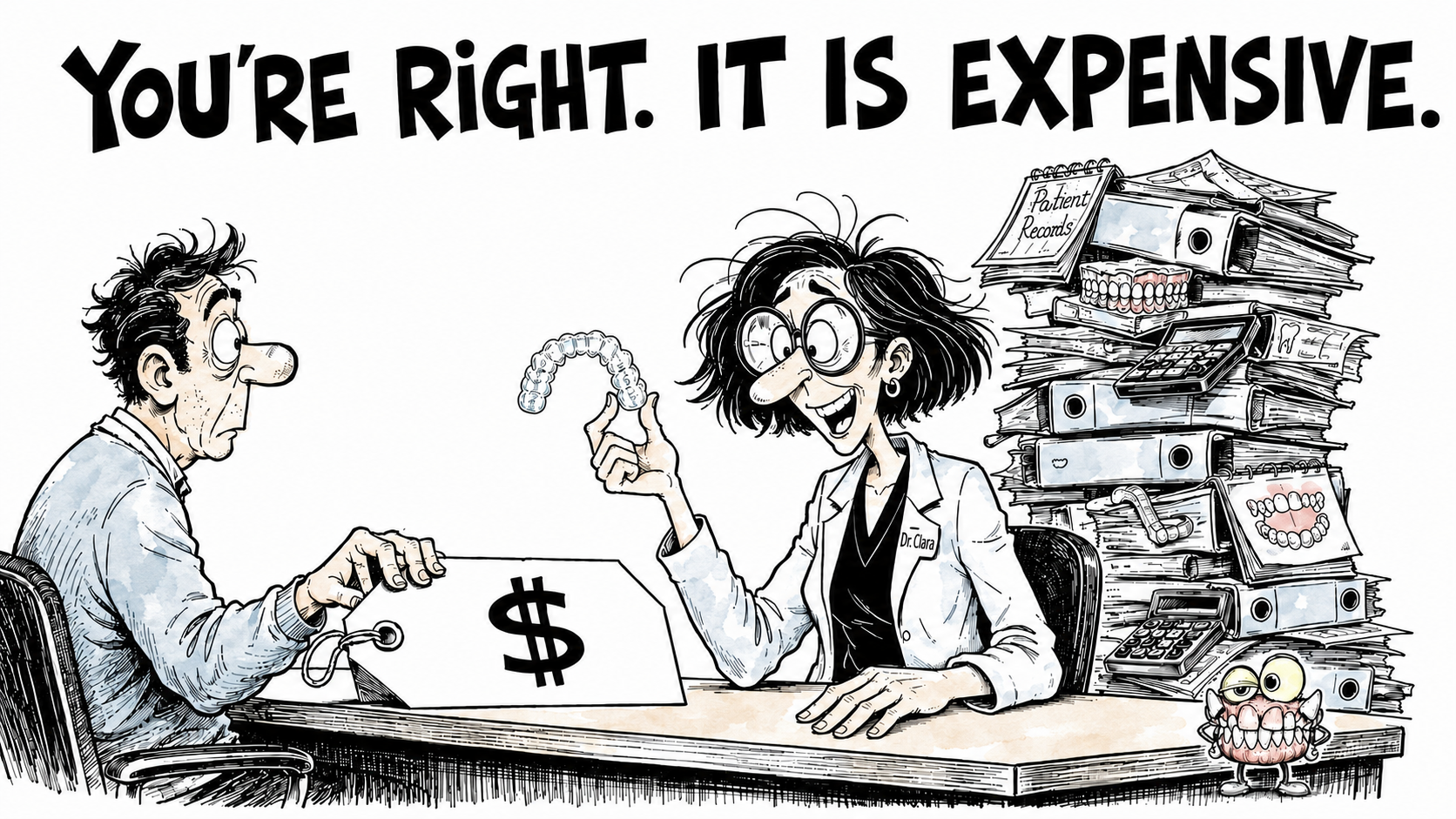
“You are right. It is expensive.”
That response acknowledges the patient’s reality.
Expensive is not an objective number. It depends on someone’s income, obligations, priorities, timing, and perception of value. A fee that is manageable for one person may be impossible for another.
It is not our role to decide what a patient should consider expensive.
Our role is to explain the diagnosis, the available options, the intended benefits, the limitations, the risks, the responsibilities, and the cost. The patient then makes an informed decision.
Agreement does not reduce the value of treatment. It creates enough honesty to discuss that value properly.
It is not for everyone
The second part of the sentence is equally important:
"It is not for everyone"
This should never be used as false scarcity or as a way to challenge the patient to prove they belong to a special group.
I mean it literally.
Clear aligner treatment is not appropriate for every clinical situation. It is not the right priority for every person at every moment. Some patients are not ready for the financial commitment. Some are not ready for the responsibility of wearing aligners. Some should address other health needs first. Some will prefer a different treatment. Others will choose no treatment.
That is their right.
When patients understand that they are allowed to say no, they often become more comfortable explaining what is really holding them back.
Is the concern cost or value?
After agreeing, pause and listen.
If clarification is needed, I would ask:
When you say it is too expensive, do you mean the treatment does not feel worth that amount, or that the amount does not fit your situation right now?"
Those are very different concerns.
If the patient does not see the value, returning immediately to payment options will not help. We may need to return to the diagnosis and explain why treatment was recommended.
If the patient sees the value but the amount does not fit the current situation, then appropriate payment arrangements or a different timeline may be discussed without changing the clinical recommendation.
If the patient simply does not want treatment, we respect the answer.
Good communication is not measured only by treatment acceptance. It is also measured by whether patients feel informed, respected, and free to decide.

It is the price of health
Clear aligner treatment is often presented as a way to obtain a nicer smile. Appearance can be an important and legitimate reason for treatment. In a comprehensive dental practice, however, alignment may contribute to much more.
Depending on the diagnosis, it may improve access for hygiene, create space for restorative care, position teeth more favorably before implants or veneers, support a more manageable occlusion, or reduce compromises in a restorative plan.
That does not mean every clear aligner treatment is medically necessary. We should never exaggerate health claims to justify a fee.
It means the conversation should focus on the patient’s diagnosis and objectives, not on pieces of plastic.
The patient is not purchasing aligners. The patient is investing in a professionally planned treatment intended to improve a specific situation.
That is why I sometimes say:
"It is the price of health."
Not as a slogan. Not as a guilt tactic. As a way to return the discussion to what we are actually treating.
If there is a meaningful health or comprehensive care benefit, explain it clearly. If the benefit is mainly esthetic, say that just as clearly.
Trust grows when value is explained honestly, not inflated.
Confidence does not need to argue
When we understand the value of what we provide, we do not need to become defensive when someone questions the price.
We can agree that it is expensive.
We can explain what treatment is intended to accomplish.
We can discuss alternatives.
We can acknowledge that it is not for everyone.
And we can allow the patient to decide.
That is not weak communication. It is confident communication.
"The goal is not to win an objection. The goal is to create enough trust for an honest decision."
This is Part 1 of a three part series about the price objection in clear aligner care. Part 1 examines the dentist’s response. Part 2 will examine the assumptions made by the dental team. Part 3 will explore why “not now” does not mean “never.”
Continue the series:
In Part 2, we will look at what happens after the patient leaves and the team concludes, often too quickly, that price was the reason the patient did not proceed.
About The CLEAR Institute
The CLEAR Institute provides education and coaching for dentists who want to integrate clear aligner treatment confidently and predictably into daily practice.
Our programs focus on understanding principles, biomechanics, and treatment planning rather than following rigid recipes.
Because when clinicians truly understand the mechanics behind clear aligner therapy, treatment planning becomes simpler, more predictable, and significantly more enjoyable.
If you would like to explore more educational resources from The CLEAR Institute:
✅ Explore all CLEAR resources, programs, and services: https://bit.ly/clearlinktree
✅ Learn more about our MOCA programs for mastering clear aligner treatment planning: https://learn.theclearinstitute.com
✅ Need help reviewing a virtual setup such as a ClinCheck? Submit your case for a personalized expert video review with ClearCheck: https://bit.ly/clear_check
These resources are designed to help dentists develop the confidence and clinical reasoning needed to integrate clear aligner therapy successfully
Share this post:
Get in touch
Let's be CLEAR
Your journey to mastering clear aligner treatment matters to us. Reach out and our team will connect with you shortly.
Fast response
Faster than a cuspid rotates
We are currently helping passionate dentists build confidence in clear aligner therapy. Stay inspired, we will be in touch soon.


Direct line
Eva Wittenberg
CLEAR Experience Manager
Languages: English, French, German, Spanish
WRITE EVALearning path
Meet with Eva
15 minute guidance call
Review your objectives, clinical experience, and the most relevant next step within the CLEAR programs.
BOOK A CALL