
Recent Post


A Tasting Guide to Cephalometric Angles
Stephane Reinhardt
Jan 30, 2026
Understanding SNA, SNB, ANB, and IMPA in Cephalometric Diagnosis
A light-hearted guide to four angles every dentist should read without breaking a sweat
By Stéphane Reinhardt, DMD
Clear Aligner Expert and Director of Education, The Clear Institute
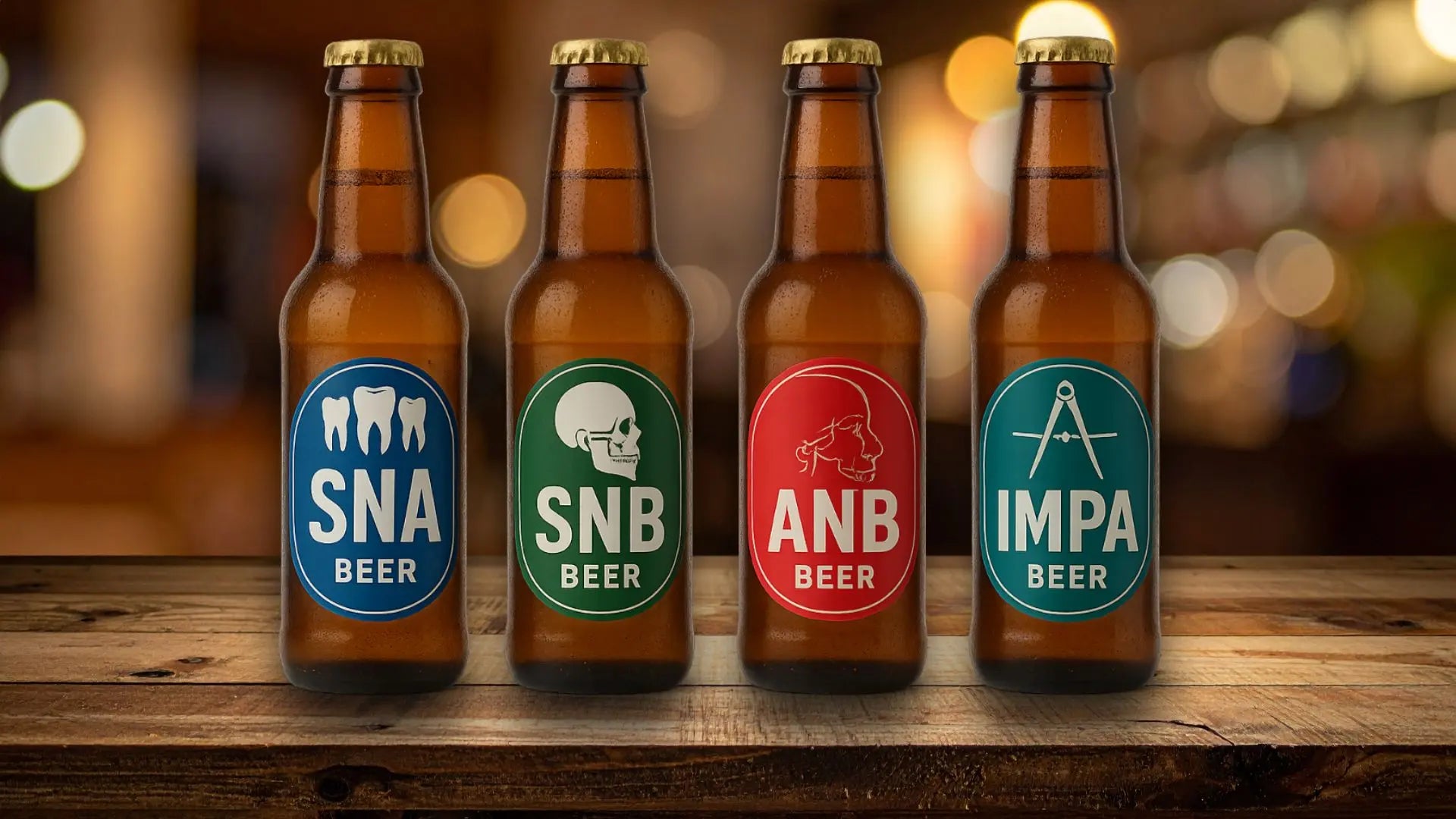
Why I Compare Ceph Angles to Craft Beer
Anyone who has ever taught cephalometrics knows one universal truth: the moment you explain angles, eyes start to glaze over.
It’s not because dentists don’t care.
It’s because cephs are too often presented like a physics exam instead of a practical diagnostic tool.
Early in my teaching career, I realised that if I wanted people to remember the fundamentals, I had to make them simple, memorable, and occasionally entertaining.
So I borrowed an analogy from outside dentistry: beer tasting.
It stuck, with students, colleagues, and even experienced orthodontists.
If you can remember four flavours of beer, you can remember four key angles.And once those angles are clear, diagnosis becomes faster and more confident.
Welcome to the Ceph Tasting Room.
01 — SNA: The Landmark LagerWhat it is: Why it matters: Beer analogy: |  |
02 — SNB: The Mandibular StoutWhat it is: Why it matters: Beer analogy: |  |
03 — ANB: The Balance BrewWhat it is: Why it matters: There’s no hiding from ANB. When you know how to read it properly, it becomes the quickest way to understand the big picture. Beer analogy: |  |
04 — IMPA: The Incisor IPAWhat it is: Why it matters: A hoppy IPA. Bold, expressive, sometimes unpredictable. A small change in IMPA can shift the entire “flavour” of the case. |  |
So Why Use Beer Analogies at All?
Because the biggest barrier to cephalometric mastery isn’t complexity, it’s the way it’s taught.
Traditionally, cephs arrive in long charts, anatomical terminology, and mathematical ranges that feel abstract until you’ve seen hundreds of cases.
That’s a problem.
Humour works for memory.
Metaphor works for understanding.
And when people enjoy learning, they learn faster and keep the knowledge longer.
Behind the jokes is a serious point:
If you can read SNA, SNB, ANB, and IMPA with confidence, you can diagnose the majority of cases with clarity.
Cephalometrics isn’t old-fashioned. It’s fundamental.
The future of orthodontics isn’t about replacing the basics, it’s about elevating them so modern tools (including aligners) actually work in your favour.
Check out our course: Cephalometrics Made Simple for Clear Aligner Dentists
Share this post:
Get in touch
Let's be CLEAR
Your journey to mastering clear aligner treatment matters to us. Reach out and our team will connect with you shortly.
Fast response
Faster than a cuspid rotates
We are currently helping passionate dentists build confidence in clear aligner therapy. Stay inspired, we will be in touch soon.


Direct line
Eva Wittenberg
CLEAR Experience Manager
Languages: English, French, German, Spanish
WRITE EVALearning path
Meet with Eva
15 minute guidance call
Review your objectives, clinical experience, and the most relevant next step within the CLEAR programs.
BOOK A CALL