
Recent Post

Archive
- November 2026
- October 2025
- July 2025
- January 2025
- November 2024
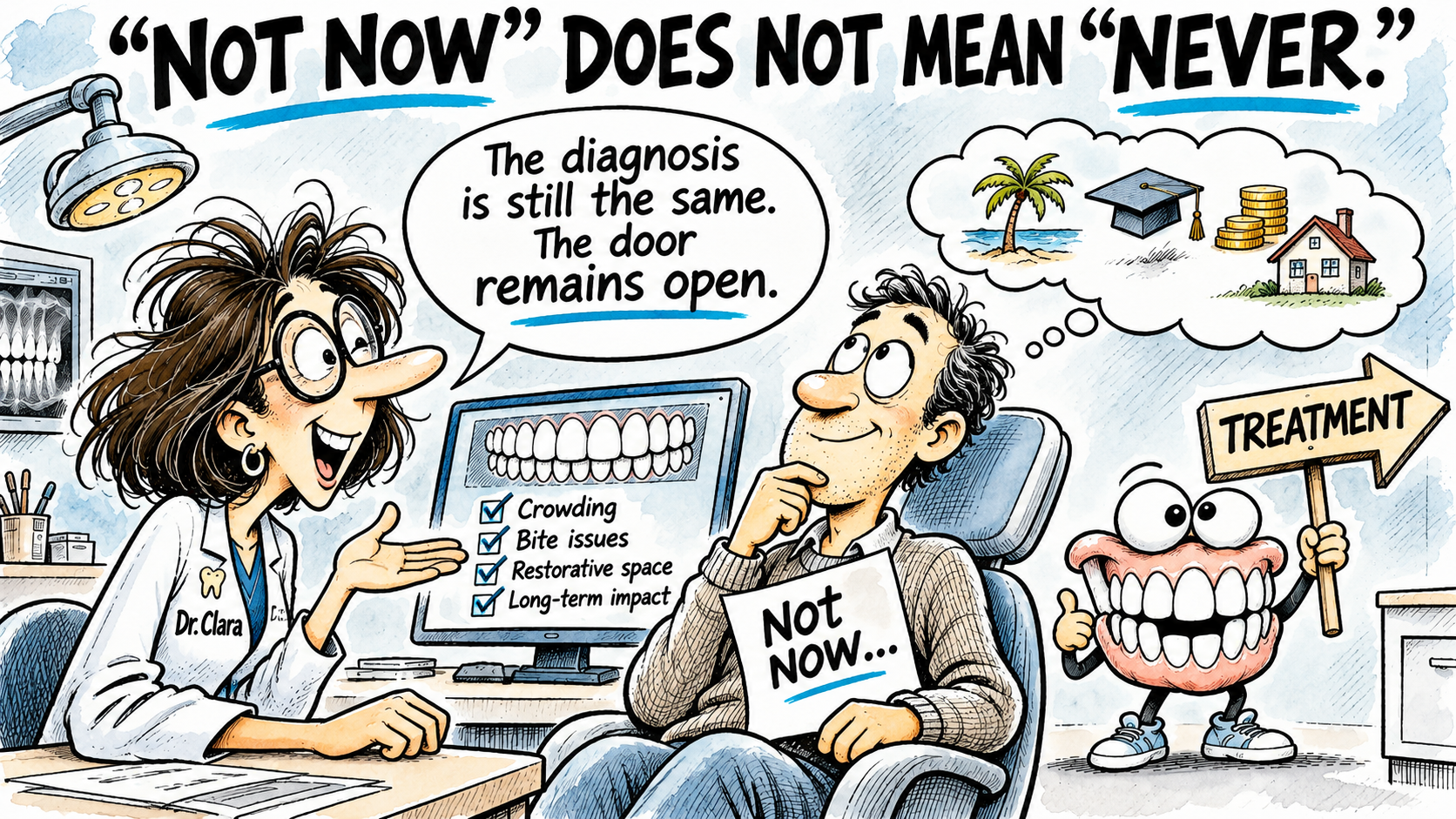
“Not Now” Does Not Mean “Never” - Part 3/3 of The price objection is not the real problem
Stephane Reinhardt
Nov 03, 2026
Some of my patients began clear aligner treatment ten or even fifteen years after our first conversation about it.
The diagnosis did not suddenly become valid on the day they said yes.
The potential value had been there all along.
What changed was the patient’s readiness.
Their priorities may have changed. Their finances may have changed. Their children may have completed treatment. A tooth may have deteriorated. A restorative need may have made alignment more relevant. Or perhaps the patient finally reached the point where the problem mattered enough to act.
We often treat a first refusal as a permanent decision.
It usually is not.
A patient can understand and still say no
A successful consultation does not always end with scheduled treatment.
A patient may understand the diagnosis, recognize the potential benefit, trust the dentist, and still decide that this is not the right time.
That decision should be respected.
But respecting “not now” does not mean pretending the clinical condition disappeared.
“No” may mean no. It may also mean not now, not yet, not while something else is more important, or not with what I currently understand.
Our role is not to repeatedly pressure the patient until the answer changes. Our role is to remain honest and clinically consistent while the condition remains relevant.
Would we stop discussing caries?
Imagine diagnosing caries, discussing treatment once, and then never mentioning the lesions at another examination because the patient did not schedule.
Imagine identifying periodontal disease, recommending care once, and then ignoring the condition at every future recall because the patient was not ready the first time.
We would not consider that appropriate care.
We would continue to examine, document, monitor, and discuss the condition. If it progressed, we would explain the change. If it remained stable, we would still acknowledge its presence.
Yet orthodontic problems are often treated differently.
We mention crowding, an unstable bite, traumatic contacts, poor tooth position, limited restorative space, or a condition that may compromise future care. The patient does not immediately show interest, so the subject disappears from every future conversation.
What does that communicate?
If the recommendation mattered only once, perhaps it never mattered very much.
Silence removes the value
Patients do not assign value only from what we say. They also assign value from how consistently we behave.
If we present alignment as an important component of comprehensive care and then never mention it again, our actions contradict our words.
The diagnosis begins to sound like an optional promotion that expired when the patient declined.
That is particularly problematic when tooth position affects hygiene, occlusion, restorative space, stability, periodontal management, or the compromises required in future care.
If we continue to see clinical value, the conversation should continue appropriately over time.
Not at every appointment in exactly the same way. Not as a repeated sales presentation. As part of responsible monitoring and ongoing diagnosis.
Consistency is not pressure
Many dentists and team members avoid revisiting orthodontic treatment because they do not want to sound pushy.
That concern is healthy. Patients should never feel pursued for treatment.
But consistency and pressure are not the same.
Pressure means repeatedly pushing a patient toward a decision for our benefit.
Consistency means continuing to observe, document, educate, and explain a relevant condition for the patient’s benefit.
At a future recall, the conversation might be simple:
“We discussed this crowding previously. You were not ready to consider treatment then, and that was completely fine. I still see the same issue today, so I want to make sure we continue to monitor it and that you understand your options.”
If the condition has changed, show the patient.
If a new restorative need makes alignment more relevant, explain the connection.
If the condition is stable, say so.
If the patient remains uninterested, respect the answer and continue appropriate documentation and monitoring.
The goal is not to manufacture urgency. It is to preserve the value of a legitimate clinical observation.
The diagnosis should lead the timing
Not every orthodontic condition has the same urgency.
Some situations should be addressed promptly. Others can be monitored. Some are primarily esthetic. Others may affect the sequence or quality of future comprehensive treatment.
That is why there can be no universal script for how often to revisit the subject.
The diagnosis, the risk, the patient’s objectives, and any observed changes should guide the conversation.
If nothing clinically relevant has changed, we do not need to recreate the entire consultation at every recall. A brief acknowledgment may be enough.
If the situation has progressed, or if a new treatment decision is affected by tooth position, a deeper conversation is appropriate.
Principles should guide the discussion, not a sales calendar.
Silence often reveals our discomfort
Why do teams stop discussing orthodontic treatment after one refusal?
Often, it is not because the patient made a permanent decision. It is because we are uncomfortable with the subject ourselves.
We are afraid of sounding pushy. We do not feel confident explaining the health or comprehensive value. We do not know how to respond to concerns about cost. We may not fully understand which problems clear aligners can help solve or how orthodontics connects with restorative care.
So we avoid the conversation.
Avoidance may feel safer, but it does not necessarily make us more ethical.
If we see genuine value for the patient, our responsibility is to explain it honestly, respect the response, and revisit the condition appropriately over time.
Confidence does not mean convincing every patient. It means being able to discuss the same diagnosis calmly whether the patient says yes, no, or not now.
Patients decide when they are ready
We cannot choose the moment when a patient becomes ready.
We can make sure that when the moment comes, the patient understands what has been observed, why it matters, what has changed, and which options remain available.
Some will proceed immediately. Some will need months. Some will need years. Some will never choose treatment.
Our responsibility remains the same: diagnose, explain, document, monitor, and respect the patient’s decision.
Respecting a patient’s decision today does not require us to erase the diagnosis tomorrow.
Did You Miss Parts 1 and 2?
This article concludes our three part series, The Price Objection Is Not the Real Problem.
If you haven't read the first two articles, here's where the conversation started:
Part 1: “You’re Right. Clear Aligner Treatment Is Expensive.”
What should we say when patients tell us treatment is too expensive? And is price really the issue?
Part 2: “The Patient Never Said No.”
What if the biggest obstacle to treatment acceptance isn't the patient, but the assumptions we make on their behalf?
Three articles. Three perspectives. One goal: Better conversations, better decisions, and better patient care.
About The CLEAR Institute
The CLEAR Institute provides education and coaching for dentists who want to integrate clear aligner treatment confidently and predictably into daily practice.
Our programs focus on understanding principles, biomechanics, and treatment planning rather than following rigid recipes.
Because when clinicians truly understand the mechanics behind clear aligner therapy, treatment planning becomes simpler, more predictable, and significantly more enjoyable.
If you would like to explore more educational resources from The CLEAR Institute:
✅ Explore all CLEAR resources, programs, and services: https://bit.ly/clearlinktree
✅ Learn more about our MOCA programs for mastering clear aligner treatment planning: https://learn.theclearinstitute.com
✅ Need help reviewing a virtual setup such as a ClinCheck? Submit your case for a personalized expert video review with ClearCheck: https://bit.ly/clear_check
These resources are designed to help dentists develop the confidence and clinical reasoning needed to integrate clear aligner therapy successfully
Get in touch
Let's be CLEAR
Your journey to mastering clear aligner treatment matters to us. Reach out and our team will connect with you shortly.
Fast response
Faster than a cuspid rotates
We are currently helping passionate dentists build confidence in clear aligner therapy. Stay inspired, we will be in touch soon.


Direct line
Eva Wittenberg
CLEAR Experience Manager
Languages: English, French, German, Spanish
WRITE EVALearning path
Meet with Eva
15 minute guidance call
Review your objectives, clinical experience, and the most relevant next step within the CLEAR programs.
BOOK A CALL